DeFi Simplified Into One Fast and Friendly Workflow
To swap a token today, a typical DeFi user opens one aggregator, compares routes, checks gas estimates, and executes. If the best route is on another chain, the user opens a bridge interface, moves the tokens, waits for confirmation, then opens a second aggregator on the destination chain. If the user also wants to provide liquidity or lend, that requires a separate protocol interface with its own approval flows, its own pool data, and its own transaction patterns.
Each step means a different interface, a different wallet prompt, a different set of assumptions about fees, a different way to display APY, and a different level of transparency about what the transaction actually does. The result is a fragmented experience where the user spends more time navigating interfaces than making decisions.
Sumex operates as a unified DeFi execution layer. Instead of opening separate protocol interfaces for each action, users access swaps, private swaps, liquidity pools, and lending pools through one workspace. Sumex aggregates swap routes from multiple providers through a unified route interface, covering same-chain and cross-chain swaps across EVM, Solana, TON, SUI, and Stellar. Liquidity and lending pool data surface opportunities across supported protocols. Private swaps offer provider-backed privacy-oriented routing for users who need it. And everything runs inside one fast, reliable, and friendly UX.
The goal is not to replace the protocols underneath. The goal is to remove the friction between the user and the action. A user who wants to swap, lend, or provide liquidity should be able to discover the options, compare them, and execute without leaving the workspace.
What Sumex Does Differently
One Dashboard for All Wallet
For the first time in the industry, users can track all their wallets within the same dashboard. No more switching between wallet apps, browser extensions, and chain-specific explorers to get a full picture of holdings. Every connected wallet, every chain, and every balance is visible in one place.
Chain and Access Agnostic by Design
Unlike many other platforms that claim multi-chain support but only cover a handful of EVM networks, Sumex actually supports EVM, Solana, TON, Tron, SUI, and Stellar. That already covers 99% of the industry. Users are not locked into one ecosystem or forced to use a different tool for each chain they operate on.
Direct Management, Not Just Tracking
Sumex goes beyond portfolio visibility. Users can directly manage their DeFi holdings and investments from the same interface where they monitor them. Provide liquidity, adjust lending positions, and execute swaps—without leaving the dashboard to interact with a separate protocol frontend.
One of the Largest Swap Route Aggregators
There is no need to open multiple aggregators and compare routes manually. Sumex is already one of the largest aggregators of swap routes in the space. More assets, more routes, more liquidity, better prices. The platform queries providers across chains and returns the best available paths so the user can focus on choosing rather than searching.
Unified Investment Tracking and Management
There is no need to track different investments manually across bookmarks and spreadsheets. Users can check their positions inside the DeFi dashboard and My Intents and manage them directly from the same app. No more getting distracted by multiple tabs, multiple logins, and multiple interfaces just to understand the state of a portfolio.
Steps
1. Connect a Wallet Bundle
Navigate to Connection Manager and add a Wallet Bundle. Select the wallet, approve the signature prompt, and confirm the wallet appears under connected sources. The Wallet Bundle links the wallet to the user's Sumex account and enables all DeFi workflows. Make sure the wallet is on the network relevant to the intended action.
2. Open the DeFi Dashboard
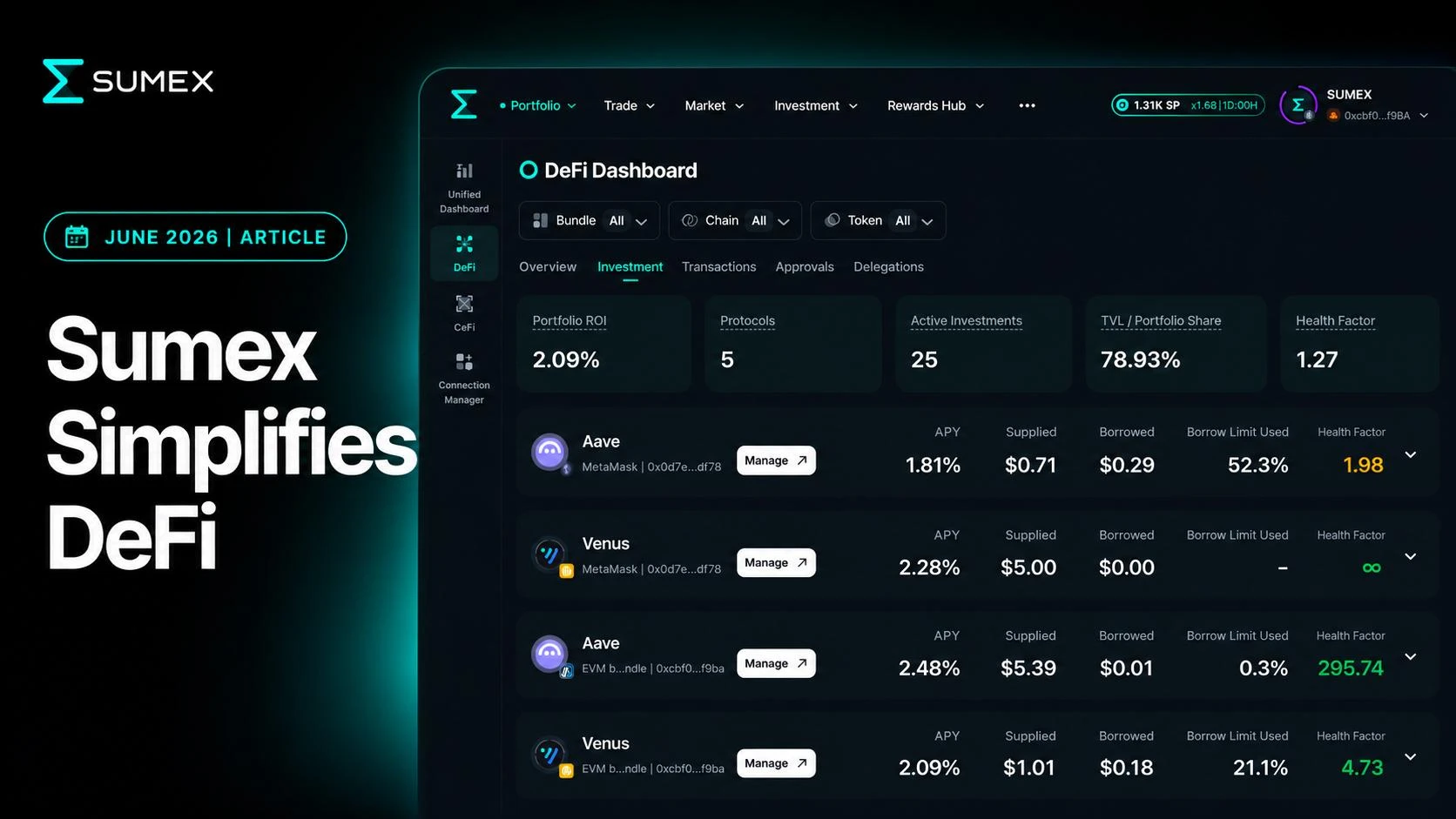
Navigate to the DeFi Dashboard in Sumex, accessible from the left sidebar below the Unified Dashboard. The dashboard organizes activity across tabs; Overview, Investment, Transactions, Approvals, and Delegations; giving a consolidated view of net worth, asset allocation, and exposure breakdown by risk tier. Holdings can be filtered by bundle, chain, or token and drilled into per-account or down to the individual token level via the Token Breakdown table. Each section works through the same unified workspace.
3. Compare and Select
For swaps: Enter the source token, destination token, and amount. Sumex queries multiple route providers and returns available paths. For each route, review the provider, estimated output, network, fees and gas, and estimated time. Compare across providers and networks; a swap on Ethereum mainnet may cost significantly more in gas than the same swap routed through a Layer 2. If privacy is needed, open Private Swap for provider-backed privacy-oriented routing.
For liquidity pools: Review the protocol, network, APY, TVL, and token pair for each opportunity. APY figures reflect current conditions and change as pool utilization shifts. Do not assume today's rate is tomorrow's rate.
For lending pools: Compare rates across protocols and assets. Understand the protocol's risk model, including smart contract risk, liquidation risk (for borrowing), and utilization-dependent rate risk before committing capital.
4. Review and Execute
Before confirming any action, verify the correct wallet bundle is selected and holds the required tokens on the correct network; any token approvals are reviewed (amount and requesting contract); slippage tolerance is set appropriately for swaps; and the transaction summary reflects the intended action, including final output, fees, and estimated settlement time. Do not rush this step. On-chain transactions are difficult or impossible to reverse after confirmation.
5. Monitor and Verify
After confirming in the wallet, the systems keeps track of the transaction through submitted, confirming, completed, or failed states. Once completed, verify the expected result: destination tokens in the wallet for swaps, position visible in the pool for liquidity provision, or lending position active for lending actions.
6. Check Verified DeFi Activity
Verified DeFi activity through Sumex may connect to eligible progress, MR opportunities, roles, and Rewards Hub campaigns. After completing a DeFi action, check whether the activity is visible in the user's profile or Rewards Hub. Do not use this connection as a reason to execute unfamiliar DeFi actions. The reward connection exists for users who are already performing DeFi activity they understand and intend to do.
Example
A user wants to do three things: swap USDC to ETH on Arbitrum, provide liquidity to a Uniswap pool, and check lending rates on Aave. Before Sumex, this meant opening a swap aggregator for the swap, going to the Uniswap interface for liquidity, and visiting the Aave dashboard for lending. Three separate interfaces, three sets of wallet prompts, three different ways of displaying data.
With Sumex, the user connects a wallet bundle that holds USDC on Arbitrum. They open just one swap widget, enter USDC to ETH, and compare multiple routes from various competing providers. They select the route with the best output for the gas cost and execute the swap. After the ETH arrives, they open the liquidity pool section, find the Uniswap ETH/USDC pool on Arbitrum, review the APY and TVL, and provide liquidity. Then they switch to the lending section, compare Aave lending rates across assets, and decide to wait because the current rate does not justify locking more capital.
Three DeFi actions, one workspace, one wallet connection, one consistent interface. The user spent time making decisions instead of navigating between platforms.
Common Mistake
Turning this into a task-and-reward-only story. The primary value of Sumex as a DeFi execution layer is the workflow itself: discovering, comparing, and executing DeFi actions from one place. Verified DeFi activity connects to eligible progress and Rewards Hub campaigns, but that connection is secondary to the execution experience. Users who see Sumex DeFi only as a way to complete reward tasks miss the core product value.
A second mistake is choosing a pool or lending position based on APY alone without understanding the protocol. A high APY number does not mean a safe or stable opportunity. Pool conditions change. Impermanent loss affects liquidity positions. Lending protocols carry smart contract risk. The user must understand the protocol, the token pair, and the risk before committing capital.
A third mistake is skipping transaction review before execution. Every on-chain action involves real assets. Confirming a swap, liquidity provision, or lending transaction without reviewing the wallet, network, token approval, and transaction summary creates avoidable risk.
When Not To Do This
- Do not execute DeFi actions on unfamiliar protocols just because they appear in the interface. Sumex surfaces opportunities from supported protocols, but availability does not equal endorsement or a safety guarantee. Research the protocol independently before committing capital.
- Do not provide liquidity without understanding impermanent loss. Liquidity pool positions are affected by price movement between the paired tokens. If the user does not understand how impermanent loss works, they should not provide liquidity until they do.
- Do not lend assets without understanding the lending protocol's risk model. Lending positions carry smart contract risk, liquidation risk (for borrowing), and utilization-dependent rate risk. Current APY does not guarantee future APY.
- Do not approve unlimited token spending without reviewing the approval. Some DeFi transactions require token approvals to smart contracts. Review the approval amount and the contract requesting access. Approve only what is needed.
- Do not execute large transactions during extreme network congestion without checking gas costs. Gas fees spike during high-demand periods. A transaction that costs a few cents under normal conditions may cost significantly more during congestion.
Checklist
- Wallet Bundle connected through Connection Manager
- The wallet holds the required tokens on the correct network for the intended action
- DeFi Dashboard opened to track the assets, risk factors, investments, and potentially vulnerable approvals & delegations
- For swaps: routes compared across providers, networks, output, fees, and settlement time
- For swaps: Private swap is considered if privacy is needed
- For liquidity, the pool protocol, network, APY, TVL, and token pair reviewed
- For lending: protocol, rate, asset, and risk model understood
- Token approval reviewed before confirming (amount and requesting contract checked)
- Slippage tolerance reviewed and adjusted if necessary
- Wallet, network, and transaction summary confirmed before execution
- Transaction executed and status monitored until settlement
- Result verified: tokens received, position visible, or lending position active
- Verified DeFi activity checked in profile or Rewards Hub (if applicable)
DeFi FAQ
What is a unified DeFi dashboard?
A unified DeFi dashboard allows users to monitor and manage wallets, swaps, liquidity positions, lending, and other DeFi activities from a single interface instead of using multiple applications.
Can Sumex manage DeFi across multiple blockchains?
Yes. Sumex provides a chain-agnostic DeFi workspace supporting EVM networks, Solana, TON, Tron, Sui, Stellar, and additional blockchain ecosystems from one platform.
Does Sumex support cross-chain and same-chain swaps?
Yes. Sumex aggregates routes from multiple liquidity providers for both same-chain and cross-chain swaps, helping users compare execution paths, pricing, fees, and available liquidity.
Can I provide liquidity and use lending protocols through Sumex?
Yes. Sumex enables users to discover, monitor, and manage supported liquidity pools and lending opportunities directly from the same DeFi workspace.
Does Sumex custody my crypto assets?
No. Sumex is a non-custodial platform. Your assets always remain in your connected wallets while Sumex provides a unified interface for managing your DeFi activity.